



.jpg)
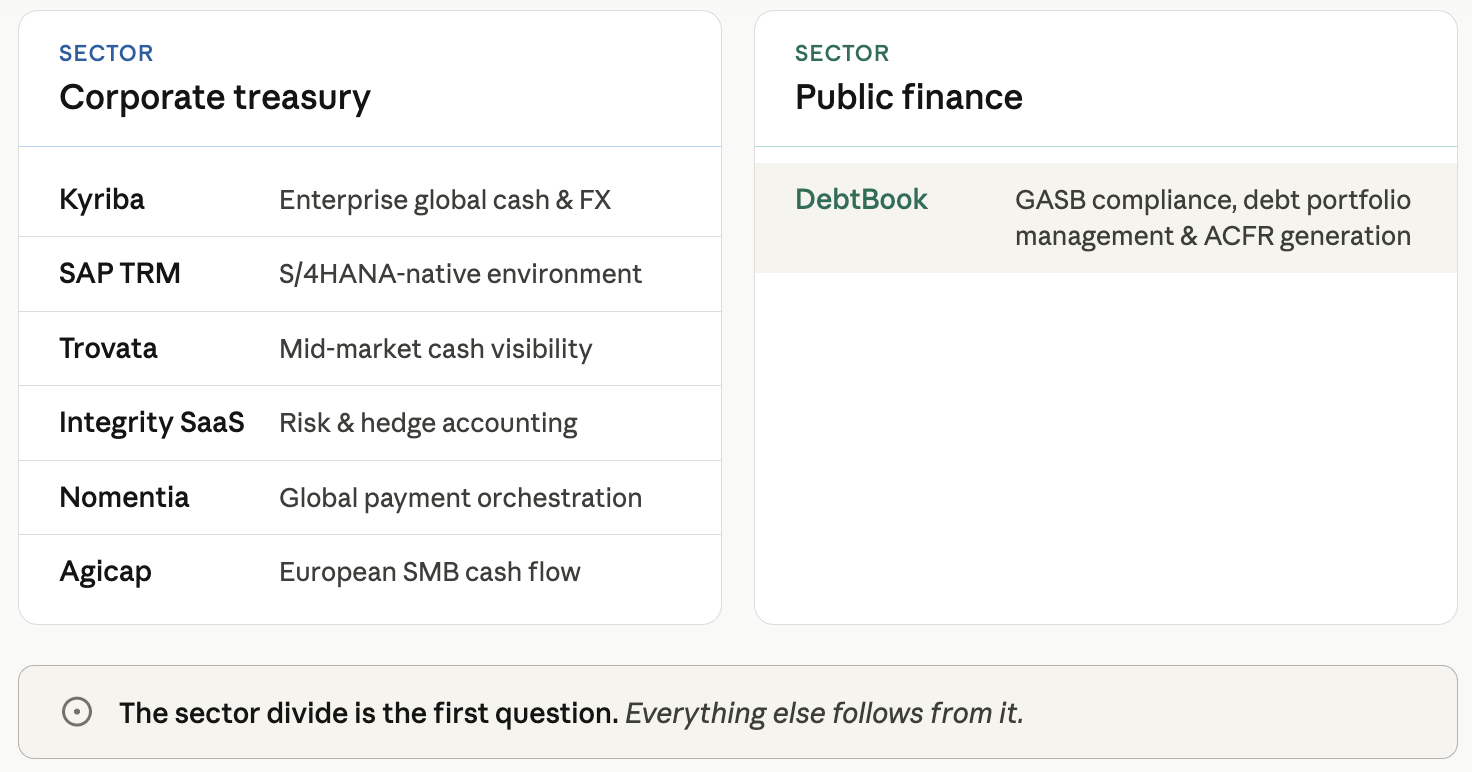
You're searching for GTreasury alternatives, which means something isn't working. Maybe the platform doesn't speak your compliance language, the implementation never delivered on its promise, or your debt manager is retiring next year and you need a system that survives the transition. Whatever brought you here, the answer depends on one question: what sector do you operate in?
The treasury management market is crowded with platforms built for corporate finance teams managing global cash pools, FX risk, and payment networks. For organizations in state and local government, higher education, healthcare, and the nonprofit sector, that mismatch means evaluating tools that look right on paper but miss the workflows that consume most of your time: GASB compliance, debt portfolio tracking, and Annual Comprehensive Financial Report (ACFR) generation. A platform that automates cross-border payments but can't produce an audit-ready footnote creates a different kind of problem.
The criteria that actually separate these platforms: public sector compliance depth, debt portfolio specificity, implementation burden, AI maturity, and key-person risk mitigation. Corporate treasury teams will find honest assessments of which tools serve their needs.
TL;DR
- Choose DebtBook if your organization operates in state or local government, higher education, healthcare, or the nonprofit sector and needs native GASB compliance automation, debt portfolio management, and ACFR footnote generation built into the same platform.
- Choose Kyriba if you run enterprise corporate treasury operations with global cash pools, FX exposure, and complex payment networks that require connectivity to thousands of banks and ERPs.
- Choose Trovata if you lead a mid-market corporate treasury team that wants fast, modern multibank cash visibility without a months-long implementation.
- Choose SAP Treasury and Risk Management if your organization already runs SAP S/4HANA and needs treasury, cash, and payments unified inside that existing environment.
- Choose Integrity SaaS Treasury Management if your mid-to-enterprise organization needs broad treasury and risk functionality including hedge accounting within a single platform.
- Choose Nomentia if your global enterprise needs centralized payment orchestration across thousands of banks and currencies.
- Choose Agicap if you're a European SMB or mid-market company managing multi-entity cash flow with a lean finance team.
Most treasury management tools are built for corporate finance. If your organization answers to GASB standards, manages a debt portfolio measured in hundreds of millions, and produces an ACFR, DebtBook is the only platform in this set designed for that reality from the ground up.
The best GTreasury alternatives at a glance
A quick look at the best GTreasury alternatives
| Tool |
Standout Feature |
Starting Price |
Best For |
| DebtBook | Automated Long-Term Obligation Disclosure | Contact for pricing | Governments, higher education, healthcare, and nonprofits |
| Kyriba |
Agentic AI for cash forecasting | Custom pricing | Midsize to enterprise companies across industries |
| Treasury and Risk Manager – Integrity Edition | Treasury GPT | Custom pricing | Mid-sized to enterprise organizations with treasury needs |
| SAP Treasury and Risk Management | S/4HANA integration, AI reconciliation, hedge accounting audit trail | Custom pricing | Large and enterprise existing SAP customers |
| Trovata | Trovata AI | $24,000/year | Mid-market to enterprise treasury finance teams |
| Agicap | AI-Powered Transaction Categorization | Custom pricing | SMBs and mid-market companies across sectors |
| Nomentia | Payment Hub | Custom pricing | Mid-sized and large global enterprises |
What makes the best GTreasury alternatives?
The treasury management market divides along a line that most comparison guides never name: corporate finance and public finance operate under fundamentally different compliance regimes, and the tools built for one rarely serve the other well.
For corporate treasury teams, the critical capabilities are global cash visibility, FX risk management, payment automation, and bank connectivity at scale.
For public finance organizations managing government debt portfolios, the critical capabilities are automating GASB compliance, generating ACFR footnotes, tracking bond schedules, and preserving institutional knowledge before experienced staff retire.
Four criteria separate the platforms that fit public finance from those that do not. Public sector compliance depth comes first, followed by how specifically the platform handles debt portfolio management, how much implementation burden the team absorbs, and whether the AI addresses actual workflows today.
How we reviewed these tools
To evaluate the best GTreasury alternatives, we analyzed G2 reviews, official product websites, and publicly available pricing pages for each competitor in this set.
We assessed each platform against the criteria most relevant to treasury and finance professionals in state and local government, higher education, healthcare, and the nonprofit sector: compliance workflow automation, debt portfolio management depth, implementation complexity, AI capabilities, and fit for the public finance operating environment.
For DebtBook, we conducted a hands-on product review and drew on documented customer outcomes from organizations including the City of Milwaukee, the City of Durham, and the City of Memphis.
Pricing information reflects what each vendor publicly discloses; where no pricing is published, we note that a sales conversation is required. Trovata is the only platform in this set with a published starting price of $24,000 per year.
Best for public finance organizations replacing legacy debt management systems with GASB-native compliance automation
DebtBook
Best For: State and local governments, higher education, healthcare, and nonprofits managing complex debt portfolios
Pricing: Contact for pricing
Trusted by: City of Milwaukee, City of Memphis, City of Durham, UNC Charlotte
DebtBook is a unified public finance platform covering debt, cash, leases, subscriptions, investments, and contracts in a single system. Every module is built around the workflows, compliance standards, and reporting structures of government and nonprofit finance, which means GASB 87, GASB 96, and ACFR generation are core to the platform's design rather than features grafted onto a corporate treasury tool.
Where platforms like Kyriba and SAP Treasury and Risk Management are optimized for global cash pools, foreign exchange hedging, and enterprise payment networks, DebtBook is optimized for bond schedules, refunding lineage, GASB compliance automation, and the audit workflows that define the public finance calendar.
Who should use DebtBook?
DebtBook fits treasury and accounting teams at state and local governments, public universities, healthcare organizations, and nonprofits that manage significant debt portfolios and face recurring GASB compliance obligations.
If your team currently tracks bond schedules in spreadsheets, spends weeks on ACFR footnote preparation, or carries key-person risk because one person understands the debt file, DebtBook addresses all three problems directly. Organizations with variable-rate debt, complex refunding histories, or multi-departmental access requirements will find the platform's depth particularly relevant.
The City of Memphis evaluated options to improve transparency and access to debt information, including state revolving fund loans and commercial paper, with visibility beyond the debt management team. Their assessment: DebtBook "was what I envisioned, but actually a little bit more."
Standout features
- DebtBook's AI Contract Processing extracts key contact data points for GASB 87 and GASB 96 compliance, eliminating manual data entry from the compliance workflow.
- Automated Long-Term Obligation Disclosure generates ACFR audit notes, debt outstanding summaries, and detailed roll-forward tables by activity and fund in a few clicks.
- True Lineage Refunding Tracking builds a complete lineage of every bond issue, tracing refundings down to the allocation level for audit-ready documentation.
How DebtBook works
DebtBook's Debt Management module functions as a single source of truth for an organization's entire debt portfolio. Treasury teams can track bond schedules, manage allocations, monitor payment activity, and build refunding lineage that traces every bond issue down to the individual allocation.
Variable Rate Debt Management automatically generates reset rates using market data integrations and identifies interest due for each reset and payment period, removing the manual calculation burden that trips up teams managing floating-rate obligations.
New Issue Structuring with Sizing lets treasury teams build scenarios, set structure and required proceeds, input interest payment details, and compare financing options before a bond goes to market, giving finance leaders a structured analytical tool rather than a spreadsheet model.
The compliance automation layer is where DebtBook separates itself most clearly from every corporate treasury tool in this comparison. Accounting teams generate full and modified accrual journal entries and GASB-compliant footnote disclosures directly from the platform.
AI Contract Processing scans lease and subscription contracts to extract key data points, including terms, payment amounts, and commencement dates, feeding the GASB 87 and GASB 96 compliance workflows without manual re-entry. The City of Durham, NC reduced debt service budget preparation from a full day to 45 minutes after moving to DebtBook, and when the city experienced a malware incident, its cloud-based architecture had the team back up and running, while the previous on-premise system offered little support.
Cash Management connects to financial institutions through secure bank APIs, pulling real-time transaction data into profiles and applying custom categorization rules automatically. Projected closing balances update in real time, and teams can build 13-month cash forecasts from the same interface.
Fraud Prevention and Bank Fee Analysis flags suspicious transactions and unusual outflows, and analyzes account analysis statements to surface potential overcharges, giving cash managers a layer of oversight that previously required manual review.
The platform operates on a cloud-based, unlimited-user model, which means access extends across departments, and auditors receive their own logins to retrieve debt documents and outstanding balances directly, reducing the bottleneck that forms when one person controls the data.
How much does DebtBook cost?
DebtBook does not publish pricing tiers. Pricing is determined through a custom quote based on the organization's size, module selection, and portfolio complexity. No free trial is available, but DebtBook offers a custom demo to walk through the platform's capabilities against your specific workflows.
FAQ
Does DebtBook offer a free trial?
No free trials are available, but DebtBook would love to show you around in a custom demo tailored to your organization's use case. Get a Demo to see the platform's debt management, compliance automation, and cash management capabilities in the context of your workflows.
How does DebtBook handle GASB 87 and GASB 96 compliance?
DebtBook's Lease Management module automates GASB 87 compliance for lease agreements covering buildings, equipment, vehicles, and land. Subscription Management handles GASB 96 obligations for subscription-based information technology arrangements, including project cost tracking for implementation costs.
Both modules use AI Contract Processing to extract key data points from contracts, then generate full and modified accrual journal entries and audit-ready footnote disclosures without manual re-entry. Accounting teams that previously spent weeks on annual compliance can complete the same work in a fraction of the time.
Is DebtBook built for large or complex debt portfolios?
DebtBook supports large, complex debt portfolios. The City of Milwaukee reduced a multi-day Tax Increment District management process to 30 minutes after evaluating five to six alternatives. This depth matters most for teams managing variable-rate debt, intricate refunding histories, or portfolios with private business use compliance requirements.
Best for enterprise corporate treasury at global scale
Kyriba
- Best For: Enterprise corporate treasury teams managing global cash, payments, and FX risk
- Pricing: Contact Kyriba for current pricing
- Free Trial: Not listed
Kyriba is a global liquidity performance platform serving 3,000 customers worldwide, processing more than $15 trillion in payments annually across 3 billion bank transactions. That scale reflects its core audience: large and mid-market corporate organizations in finance, technology, retail, manufacturing, and insurance that need a single platform to consolidate global cash positions, automate payments, and manage foreign exchange exposure.
The platform's connectivity spans over 9,900+ bank connections, plus ERP and treasury system integrations (including SAP and Oracle Fusion), which gives enterprise teams a realistic path to replacing fragmented portals and spreadsheets with a unified operational picture.
Where Kyriba earns its reputation is in the breadth of its treasury function coverage. Real-time cash positioning, AI-powered liquidity forecasting through its dedicated agentic AI product TAI, payments automation with bulk processing capabilities, and structured approval hierarchies with segregation of duties are all available within one platform.
G2 reviewers highlight the ability to process up to 100 payments in a single batch as a concrete workflow improvement, and the platform's enforcement of approval workflows gives treasury teams the internal controls that enterprise finance departments require. The tradeoff is implementation complexity: users consistently note that setup is time-consuming, requires specialized knowledge, and can increase dependency on external administrators or support resources.
Who should use Kyriba?
Kyriba fits enterprise and mid-market corporate treasury teams that operate across multiple banks, currencies, and geographies and need a platform that handles the full complexity of global liquidity management.
Organizations already running SAP or Oracle Fusion will find the integration path well-documented and user-validated. Treasury teams that process high volumes of payments daily, manage FX exposure, and need real-time visibility into liquidity across entities will get the most from the platform's depth, provided they have the internal capacity or external support to manage a configuration-intensive implementation.
Standout features
- Kyriba's TAI agentic AI product delivers real-time cash forecasting and liquidity scenario modeling across risk exposures.
- Connectivity to over 9,900 banks, ERPs, and treasury systems provides one of the broadest integration networks available in corporate treasury software.
- Structured payment automation with bulk processing, approval workflows, and segregation of duties supports enterprise-grade internal controls.
How Kyriba works
Kyriba connects to an organization's banking infrastructure, ERP systems, and payment networks through its integration layer, pulling transaction data into a centralized cash position that updates in real time.
Treasury teams log into a single interface rather than cycling through multiple bank portals, and the platform applies configurable categorization rules and approval hierarchies to structure how cash movements are reviewed and authorized.
The result is a consolidated operational view of global liquidity that replaces the manual aggregation work that typically consumes treasury staff hours each morning.
The platform's AI capabilities extend that foundation into forecasting. TAI, Kyriba's agentic AI product, models liquidity scenarios and generates cash forecasts by analyzing transaction patterns and exposure data, giving treasury teams a forward-looking view alongside the real-time position.
Payments automation handles routine disbursements through bulk processing and automated reconciliation, reducing manual entry and the error risk that comes with it. For organizations managing FX exposure, the platform monitors currency positions and supports risk management workflows alongside the core cash and payments functions.
Where implementation demands attention is in configuration. G2 reviewers describe the setup process as requiring significant time and specialized knowledge, and some workflows depend on dedicated administrators to maintain.
Organizations evaluating Kyriba should factor in the internal resource commitment or external support budget that a full deployment requires, particularly if they are migrating from a simpler or more manual treasury environment.
How much does Kyriba cost?
Kyriba does not publish pricing publicly. Contact Kyriba directly for current pricing details.
FAQ
Q: How difficult is it to implement Kyriba, and what should organizations expect during setup?
Implementation is consistently described by G2 reviewers as time-consuming and configuration-intensive. The platform's breadth means there are many modules and workflows to configure, and some organizations report needing specialized knowledge or external support to complete the setup properly.
Treasury teams should plan for a meaningful implementation timeline and assess whether they have the internal capacity or budget for external assistance before committing. Organizations with dedicated treasury IT resources or existing relationships with SAP or Oracle implementation partners will be better positioned to manage the process.
Q: Does Kyriba support public sector compliance requirements like GASB reporting or ACFR footnote generation?
Kyriba's documented capabilities do not include GASB compliance workflows, ACFR footnote generation, or government fund accounting structures. The platform is designed for corporate treasury use cases across commercial industries, and its compliance features reflect that focus: hedge accounting audit trails, FX risk documentation, and payment controls built for corporate finance environments.
Organizations in state and local government, higher education, healthcare, or the nonprofit sector with GASB reporting obligations should evaluate platforms built specifically for those requirements.
Best for mid-to-enterprise corporate treasury and risk management
Integrity SaaS Treasury Management
- Best For: Mid-to-enterprise organizations managing complex treasury and hedge accounting needs
- Pricing: Contact FIS for current pricing
- Free Trial: Not listed
FIS Treasury and Risk Manager, Integrity Edition positions itself as a single path from basic cash positioning to the full complexity of hedge accounting, which means it can grow alongside an organization's treasury requirements without requiring a platform change. The system automates core treasury functions, including cash flow documentation, investment schedule management, and amortization tracking for complex and dynamic portfolios.
Its Treasury GPT feature, an in-platform large language model, lets users query the system directly about configuration and operational practices, reducing the friction that typically accompanies onboarding and ongoing administration.
Where Integrity SaaS earns its credibility is in the depth of its risk and amortization capabilities. Users report that the platform handles complicated amortization schedules for company investments that would otherwise require manual tracking, and that its transaction records provide a reliable foundation for year-end audit preparedness.
That combination of operational efficiency and audit readiness makes it a credible option for treasury teams carrying significant investment complexity. The integration story is more complicated: G2 reviewers flag that connecting Integrity SaaS to external systems is "tricky” and “very difficult," which matters for organizations expecting smooth ERP or bank connectivity from day one.
Who should use Integrity SaaS Treasury Management?
Integrity SaaS fits mid-to-enterprise corporate organizations that need a single platform spanning basic cash positioning and sophisticated hedge accounting, particularly those managing complex investment portfolios with dynamic amortization schedules.
Treasury teams that prioritize audit-ready transaction records and want an AI assistant for in-platform guidance will find the feature set well-matched to their needs. Organizations with significant corporate risk management requirements, including FX exposure and hedge strategy documentation, are the clearest fit.
Standout features
- Treasury GPT: An in-platform large language model that responds to queries about usability, configuration, and operational practices.
- Hedge accounting support: Manages the full complexity spectrum from basic cash positioning through compliant hedge accounting strategies.
- Complex amortization tracking: Automates dynamic amortization schedules for investment portfolios that are otherwise difficult to manage manually.
How Integrity SaaS Treasury Management works
FIS built Integrity SaaS around a core premise: treasury complexity should not require multiple platforms. The system handles the full range of corporate treasury functions within a single environment, connecting ERP systems, specialized financial systems, and FIS SWIFT Services through configured integrations.
Treasury GPT sits on top of that operational layer, giving users a conversational interface for configuration questions and workflow guidance rather than routing every query through a support ticket.
The platform's investment management capabilities are where it differentiates most clearly from lighter-weight cash visibility tools. Integrity SaaS automates the investment schedules and amortization calculations that consume significant manual hours in organizations managing complex portfolios, and it maintains a transaction-level audit trail that supports year-end audit workflows.
For organizations managing both routine cash positioning and sophisticated risk instruments, those capabilities coexist in one system rather than requiring separate point solutions.
Integration is the area requiring the most planning. Connecting Integrity SaaS to external systems, including ERPs and bank platforms, has been described by G2 reviewers as technically demanding. Organizations evaluating the platform should factor in the internal technical resources or implementation support needed to establish those connections before go-live.
How much does Integrity SaaS Treasury Management cost?
FIS does not publish pricing for Integrity SaaS Treasury Management. Contact FIS directly for current pricing based on your organization's size and requirements. G2 reviewers note that pricing can be a barrier for smaller or lower-margin organizations, which suggests the cost structure is calibrated toward mid-market and enterprise buyers.
FAQ
Q: Does Integrity SaaS Treasury Management support hedge accounting compliance documentation?
Yes. Hedge accounting is one of Integrity SaaS's core capabilities, and the platform is designed to handle the full complexity spectrum from basic cash positioning through hedge strategy documentation. For organizations that need to manage FX exposure, interest rate risk, and compliant hedge accounting in a single system, this is one of the stronger options in the mid-to-enterprise corporate treasury market.
Q: How difficult is it to integrate Integrity SaaS with existing ERP systems?
FIS positions ERP and SWIFT integration as a configured capability, and the platform is designed to automate data flows between ERPs, specialized systems, and bank networks. In practice, G2 reviewers describe the process of connecting Integrity SaaS to external products as "tricky and very difficult," so organizations should plan for dedicated technical resources during implementation rather than assuming a plug-and-play experience.
Best for large enterprises running SAP S/4HANA
SAP Treasury and Risk Management
- Best For: Large enterprises already committed to the SAP S/4HANA environment
- Pricing: Contact SAP for current pricing
- Free Trial: Not listed
SAP Treasury and Risk Management is delivered as a module within SAP S/4HANA Cloud. For organizations already running SAP ERP, that architecture is a genuine strength: cash management, forecasting, and payments unify in a single system rather than requiring a separate integration layer.
The platform automates bank statement reconciliation using AI, generates cash positions from integrated data sources, and maintains full audit trails for hedge accounting strategies, giving enterprise treasury teams a unified view of liquidity and financial risk without leaving the SAP environment.
Where SAP Treasury and Risk Management earns its reputation is in financial risk management depth. The platform monitors risk positions and currency conversion rates to support compliant hedge accounting strategies, a capability that corporate treasury teams managing FX exposure and complex borrowing structures rely on. U
sers on G2 consistently describe the platform as reliable and well-optimized for operational treasury problems, particularly when the underlying SAP infrastructure is already in place. The trade-off is that this depth comes with significant setup complexity: reviewers describe initial configuration as requiring careful planning and specialized technical expertise, and some modules feel less modern than newer treasury tools built on contemporary UI frameworks.
Who should use SAP Treasury and Risk Management?
SAP Treasury and Risk Management fits large enterprise organizations already running SAP S/4HANA that need native integration between treasury operations, cash forecasting, and financial risk management.
It's particularly well-suited to organizations with dedicated IT resources and treasury teams managing FX exposure, hedge accounting, and complex borrowing structures across multiple entities. If your organization has already committed to the SAP environment and needs treasury functionality that operates within that infrastructure rather than alongside it, this is the logical choice.
Standout features
- Native SAP S/4HANA integration unifies cash management, forecasting, and payments in one environment without a separate integration layer.
- Hedge accounting audit trail monitors risk positions and currency rates to support compliant FX risk management strategies.
How SAP Treasury and Risk Management works
SAP Treasury and Risk Management operates as an integrated module within SAP S/4HANA Cloud, so the platform's core advantage is that treasury data lives in the same system as the broader enterprise financial record.
Cash positions are generated automatically from integrated sources, bank statement reconciliation runs through AI-assisted processing, and payments are confirmed through two-way integration with multiple trading platforms. For organizations already in the SAP environment, this architecture eliminates a category of data synchronization problems that standalone treasury tools typically require middleware to solve.
The financial risk management capabilities follow the same integrated logic. The platform monitors FX exposure and interest rate risk, supports hedge accounting strategies with structured audit trails, and enables liquidity scenario modeling alongside cash forecasting. These are capabilities built for corporate treasury teams managing complex borrowing structures and currency risk across global operations.
The implementation reality, however, deserves honest attention. G2 reviewers consistently note that configuration requires significant technical expertise and careful planning, and that some modules still require manual data aggregation despite the platform's automation features. Organizations without dedicated SAP administrators or IT resources to support the initial build should factor that resource requirement into any timeline estimate.
How much does SAP Treasury and Risk Management cost?
SAP does not publish pricing for Treasury and Risk Management. Contact SAP directly for current pricing based on your organization's size, existing SAP licensing, and the specific modules required.
FAQ
Q: Does SAP Treasury and Risk Management work if my organization doesn't already use SAP S/4HANA?
SAP TRM requires an SAP ERP backbone. Organizations not on SAP S/4HANA could deploy it on SAP ECC or migrate to S/4HANA, but it is never a standalone product. A non-SAP shop would not deploy TRM in isolation. Organizations without an existing SAP environment should expect substantially higher implementation complexity and cost, since they would effectively be adopting two interconnected systems rather than extending one.
Q: How does SAP Treasury and Risk Management handle hedge accounting compliance?
The platform maintains a full audit trail for hedge accounting strategies, monitoring risk positions and currency conversion rates to support compliant FX risk management. This is one of the capabilities that enterprise treasury teams with complex FX exposure specifically seek out in SAP's platform.
The audit trail documentation is built into the workflow rather than generated as a separate export, which supports both internal controls and external audit requirements for organizations managing significant currency risk across multiple entities.
Best for real-time corporate cash visibility without heavy IT involvement
Trovata
- Best For: Mid-market treasury teams wanting fast, modern multibank cash visibility
- Pricing: Starting at $24,000/year, billed annually
- Free Trial: Not listed on pricing page
Trovata is a modern cash management platform built to replace the daily ritual of logging into multiple bank portals and manually consolidating balances into a spreadsheet. It connects directly to banks via API and pulls transaction data continuously into a single view, so treasury teams get real-time cash positioning across entities without IT configuring or maintaining the connections.
Built on that data foundation, Trovata AI adds three capabilities: Chat handles natural language Q&A against your cash data, Insights surfaces anomalies proactively, and Agents schedule recurring automation tasks.
Where Trovata earns its reputation is in the speed of that visibility. Corporate treasury teams managing cash across multiple banks and legal entities can see consolidated positions, run ad-hoc transaction searches, and generate reports without the manual aggregation work that consumes hours in legacy environments.
The platform also executes payments natively, supporting RTP, ACH, and wire transfers through direct bank API connections rather than routing through third-party payment vendors, which matters for teams that want to consolidate cash visibility and payment execution in one place.
Who should use Trovata?
Trovata fits mid-market to enterprise corporate treasury teams whose primary challenge is multibank cash visibility and reporting. It's particularly well-suited to lean treasury functions where IT resources are limited, since the platform is designed for setup without heavy technical involvement.
Organizations managing cash across multiple banks and entities, running frequent ad-hoc reporting, and looking to automate recurring treasury tasks through AI-driven scheduling will find Trovata's feature set closely matched to those workflows. The published starting price of $24,000 per year also gives budget-conscious teams a concrete number to evaluate before entering a sales conversation.
Standout features
- Trovata AI delivers three production-ready capabilities: natural language cash Q&A, proactive anomaly detection, and scheduled automation agents.
- Native payments execution supports RTP, ACH, and wire transfers directly through bank APIs, eliminating reliance on third-party payment vendors.
- Multibank data aggregation connects, normalizes, and continuously refreshes bank data across institutions into a single consolidated cash position.
How Trovata works
Trovata's architecture starts with direct bank API connections that pull transaction and balance data continuously, normalizing it across institutions so the platform always reflects current positions rather than yesterday's export.
Once the data foundation is established, treasury teams work from a single portal instead of rotating through individual bank interfaces, with all balances and transactions searchable and reportable from one place. The setup is designed to minimize IT dependency, which shortens the path from contract to working dashboard compared to platforms that require significant technical configuration.
The AI Suite layers onto that data foundation in three distinct modes. AI Chat lets users ask questions in natural language and receive answers drawn from live transaction data. AI Insights monitors for patterns and anomalies proactively, surfacing exceptions before a user thinks to look for them.
AI Agents handle scheduled automation: recurring reports, routine data pulls, and other repeating tasks that would otherwise consume analyst time. Together, these capabilities represent a coherent AI strategy rather than a single feature bolted onto a legacy platform.
Payments execution is integrated directly rather than handled through a separate vendor. Trovata supports real-time payments, ACH, and wire transfers through the same bank API connections that power cash visibility, so teams can act on their cash position without switching platforms.
For treasury functions that currently manage visibility in one tool and payments in another, this consolidation reduces both operational complexity and the reconciliation work that comes from maintaining parallel systems.
How much does Trovata cost?
Trovata publishes its starting price, which is $24,000 per year, billed annually. The entry tier includes one bank connection, 100 accounts, one million transactions, and ten users. Enterprise pricing is available on a custom basis. Contact Trovata directly or visit their pricing page for current plan details and higher-tier options.
FAQ
Q: How difficult is Trovata to configure for a team without dedicated treasury technology resources?
Trovata is designed to reduce IT dependency, and reviewers generally describe the interface as intuitive once the platform is running. That said, the initial configuration of data streams and the transaction tagging system carries a noted learning curve, with some users describing the setup process as requiring meaningful time investment before the platform delivers its full value. Teams without a dedicated treasury analyst or someone willing to invest in that configuration phase should factor that ramp into their evaluation timeline.
Q: Does Trovata support cash flow forecasting, and how customizable are those forecasts?
Trovata includes cash flow forecasting capabilities built on its real-time bank data foundation. However, some reviewers have flagged the forecasting tools as limited in customization, noting that the current feature set doesn't fully accommodate the range of scenarios or forecast structures they need. Teams with straightforward forecasting requirements are likely to find the functionality sufficient, while those with complex multi-entity or multi-currency forecasting needs should test those workflows specifically during a proof-of-concept evaluation.
Best for European SMB and mid-market cash flow management
Agicap
- Best For: European SMBs and mid-market companies managing multi-entity cash flow
- Pricing: Contact Agicap for current pricing
- Free Trial: Not listed on pricing page
Agicap is a European cash flow management platform serving over 8,000 clients across 12 countries, built around the operational reality of finance teams managing multiple entities, currencies, and bank accounts from a single interface. Its core strength is accessibility: the platform connects to banks and ERP systems via Open Banking APIs, automates transaction categorization using AI, and presents cash positions through visual dashboards that reviewers consistently describe as intuitive even for non-financial profiles.
Rolling 13-week cash flow planning tools let teams build and adjust forecasts quickly, and OCR-based accounts payable automation with approval workflows extends the platform's reach into supplier invoice processing.
Where Agicap draws its clearest boundaries is in geographic and organizational scope. The platform is designed for European commercial organizations, and its feature set reflects that context: multi-currency aggregation, Open Banking API connectivity calibrated to European banking infrastructure, and AP automation workflows suited to commercial invoice processing.
Agicap's documented capabilities do not include GASB compliance workflows, debt portfolio management, or government audit note generation. Organizations operating outside Europe or requiring public-sector accounting standards will find the platform's architecture points in a different direction.
Who should use Agicap?
Agicap fits European SMBs and mid-market companies whose primary treasury challenge is consolidating cash visibility across multiple entities and bank accounts. Finance teams that spend significant time logging into separate banking portals, manually reconciling multi-currency positions, or routing supplier invoices through disconnected approval chains will find the platform's Open Banking connectivity and AP automation directly address those friction points. Organizations with a lean treasury function that need forecasting and cash monitoring without a heavy implementation lift are the clearest fit.
Standout features
- AI-powered transaction categorization automatically matches bank transactions with invoices across multiple entities and currencies.
- OCR-based accounts payable automation processes supplier invoices with approval workflows and automated payment execution.
- Open Banking API connectivity aggregates and synchronizes multi-currency cash positions across banks and ERP systems in real time.
How Agicap works
Agicap connects to a company's banks and ERP systems through Open Banking APIs, pulling transaction data automatically and normalizing it across entities and currencies into a single cash management view. AI-powered categorization applies to incoming transactions. It matches bank activity against invoices and flags items that need attention, which reduces the manual reconciliation work that consumes time in multi-entity finance teams. The platform's visual dashboards present consolidated positions in a format designed for fast interpretation, a deliberate choice that extends usability beyond treasury specialists to broader finance and management stakeholders.
From that cash visibility foundation, Agicap extends into forecasting and payables. The rolling 13-week planning tools let teams build short- and medium-term cash projections and adjust them as conditions change, with the goal of supporting faster decisions on liquidity. The accounts payable module adds OCR-based invoice capture, approval routing, and payment execution, bringing supplier payment workflows into the same platform rather than leaving them in disconnected systems.
Reviewers note that the centralization of multiple entities into one view is where the platform delivers its most tangible value, particularly for fund managers and holding structures overseeing a range of operating companies.
How much does Agicap cost?
Agicap does not publish pricing publicly. Contact Agicap directly for current plan pricing and details.
FAQ
Q: How long does Agicap's onboarding typically take, and what does setup involve?
Reviewers on G2 describe the initial setup as complex and time-consuming, with multiple meetings required to align the platform's configuration to specific company needs. The process involves connecting bank accounts via Open Banking APIs, integrating with ERP systems, and establishing categorization rules and approval workflows.
Agicap's support team receives consistent praise for responsiveness during this period, which reviewers credit with making the onboarding manageable despite its complexity. Organizations with a lean finance team should factor implementation time into their evaluation timeline.
Q: Does Agicap support multi-currency and multi-entity treasury management?
Multi-entity and multi-currency cash centralization is one of Agicap's primary strengths. The platform connects to banks across multiple countries via Open Banking APIs, aggregates positions in different currencies, and presents consolidated views across entities in a single interface.
Reviewers managing dozens of bank accounts across varied legal structures describe this consolidation capability as the feature that most directly addresses their operational challenge. Organizations with complex European holding structures or subsidiaries operating across multiple currencies are the clearest fit for this capability.
Best for global enterprise payments and multi-bank connectivity
Nomentia
- Best For: Global enterprises centralizing cross-border payments, FX risk, and multi-bank connectivity
- Pricing: Contact Nomentia for current pricing
- Free Trial: Not listed on pricing page
Nomentia is a modern SaaS cash and treasury management platform serving over 1,400 companies across more than 80 countries. Its core strength is payment orchestration at scale: a centralized payment hub that connects ERPs, financial systems, and banks to automate local, cross-border, and global payments from a single point.
That connectivity extends to over 10,000 banks globally, with fully managed connections and file format conversions that reduce the technical burden on treasury teams handling diverse banking relationships. The platform also provides real-time cash visibility across 2,500-plus banks and applies machine learning to develop cash flow forecasts automatically.
Where Nomentia earns its strongest reviews is in FX automation and transparency. Users credit the platform with reducing the manual Excel management that typically accompanies foreign exchange exposure tracking, and the customizable payment approval workflows accommodate the complex group structures that large global enterprises operate within.
Who should use Nomentia?
Nomentia fits mid-sized to large enterprises that manage significant global payment volumes across multiple banks, currencies, and legal entities. Organizations with complex FX exposure, cross-border payment workflows, and a need to harmonize payment approvals across a large group structure will find the platform's payment hub and risk management capabilities directly relevant. It suits treasury teams that have outgrown legacy systems and want a cloud-based alternative with broad bank connectivity and managed format conversions, without requiring the implementation footprint of a platform like SAP Treasury and Risk Management.
Standout features
- Nomentia's payment hub centralizes local, cross-border, and global payments across ERPs, financial systems, and banks in one workflow.
- Bank connectivity spans over 10,000 institutions globally, with fully managed connections and automated file format conversions.
How Nomentia works
Nomentia's payment hub sits at the center of the platform, pulling together connections from ERP systems and financial platforms to route payments through a single, controlled channel. Cash visibility and risk management build on that foundation. This architecture is designed to eliminate the fragmented payment workflows that emerge when large organizations manage dozens of banking relationships independently, each with its own format requirements and approval processes.
Cash visibility works through Nomentia's bank connectivity layer, which aggregates real-time positions across a broad network of financial institutions. The platform applies machine learning to that consolidated data to generate cash flow forecasts, reducing the manual effort of pulling and reconciling bank data from multiple sources. For organizations managing cash across multiple currencies and geographies, this real-time aggregation is the operational foundation everything else builds on.
The FX and risk management module extends that visibility into exposure management, giving treasury teams a structured process for identifying key risk drivers and implementing hedging strategies. Users can track FX exposure across the portfolio and automate core hedging processes, replacing the manual spreadsheet workflows that introduce both errors and delays. Together, these three layers form a connected treasury workflow rather than a collection of standalone tools.
How much does Nomentia cost?
Nomentia does not publish pricing publicly. Contact Nomentia directly for current pricing details specific to your organization's size, bank connections, and module requirements.
FAQ
Q: How difficult is Nomentia to configure and maintain after implementation?
Nomentia users consistently describe the initial implementation as faster and more intuitive than legacy treasury systems, and the HTML5 interface earns strong marks for day-to-day usability. That said, G2 reviewers note that parameter settings and mapping tables can become complex as configurations grow, and some users feel the platform's guidance for those configurations is insufficient. Organizations with dedicated treasury operations staff or an implementation partner will be better positioned to manage ongoing configuration than lean teams without that internal expertise.
Q: Does Nomentia support advanced reporting and analytics out of the box?
Nomentia provides predefined report structures for standard treasury reporting needs. However, users who require advanced functionality, specifically the ability to pivot data in Excel downloads, have noted that this capability requires an additional upcharge rather than being included in the base platform. Organizations with complex, ad hoc reporting requirements should clarify exactly which reporting features are included in their specific contract before signing, to avoid discovering that the analysis workflows they rely on carry additional cost.
Why DebtBook is the best GTreasury alternative for public finance organizations
If your organization adheres to GASB standards, manages a complex debt portfolio, and produces an ACFR, DebtBook is the only platform in this set built for that reality from the ground up.
Disclaimer
The information provided in this article is accurate at the time of publication in 2026. Product features, pricing, and availability are subject to change. We recommend verifying current details directly with each vendor before making a purchasing decision. Competitor information is sourced from G2 reviews, official product websites, and publicly available pricing pages.
Related Treasury Management Reading
- Modernize Your Treasury Management Operations Through AI and Automation- Without Losing Control
- [Survey] The Biggest Priorities (& Barriers ) Facing Public Finance Leaders Today
- 6 Ways to Ensure Your Treasury Spend Can Withstand Audit and Oversight
Disclaimer: DebtBook does not provide professional services or advice. DebtBook has prepared these materials for general informational and educational purposes, which means we have not tailored the information to your specific circumstances. Please consult your professional advisors before taking action based on any information in these materials. Any use of this information is solely at your own risk.


.jpg)
.jpg)
.jpg)