



For public finance leaders, recent years have shown that regulations are evolving and becoming more complex. At the same time, workforce changes and retirements are reshaping how teams operate. Add in heightened expectations for transparency and accountability, and it’s clear that public finance leaders are operating under significant pressure.
To gain a deeper understanding of how leaders are handling these pressures, we surveyed professionals across local governments, state agencies, higher education institutions, utilities, and healthcare organizations. Their responses reveal the challenges and priorities shaping the future of public finance.
What we found is both reassuring and surprising.
The Top Priorities of Public Finance Leaders
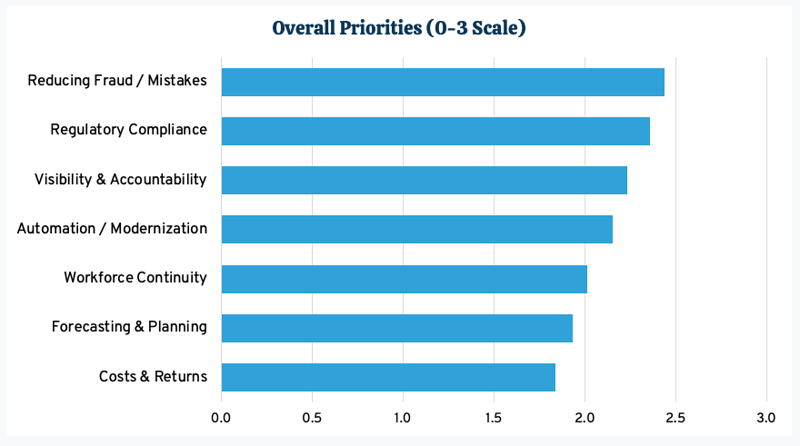
When asked what matters most, public finance leaders were consistent: protecting trust comes first.
Source: DebtBook Survey
1. Compliance and Risk Reduction Lead the Way
Across the board, compliance, transparency, and fraud prevention ranked highest. Leaders see protecting taxpayer dollars and ensuring accountability as more urgent than chasing higher investment returns or cutting borrowing costs.
Source: DebtBook Survey
2. Modernization is Rising, But Not for Everyone
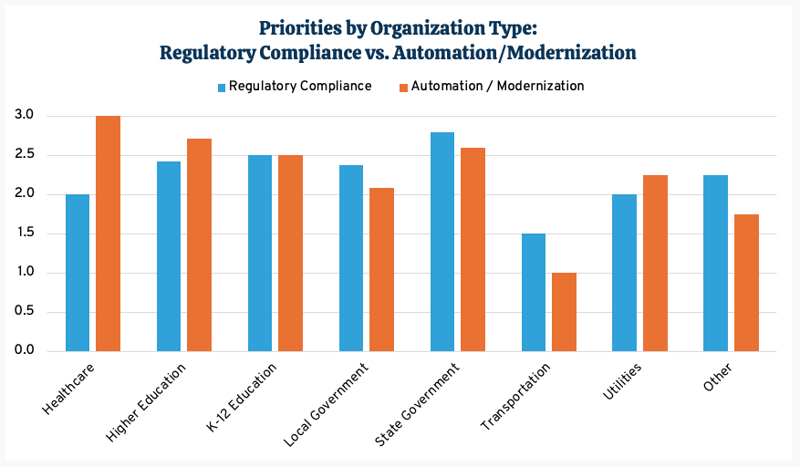
Higher education institutions, healthcare systems, and enterprise-sized organizations are leaning heavily into automation and forecasting, recognizing the efficiencies and future-proofing these tools provide.
Local governments and mid-sized teams, however, continue to anchor their priorities in compliance and fraud prevention which could be a reflection of their immediate pressures and resource constraints.
Source: DebtBook Survey
3. Different Roles, Distinct Priorities
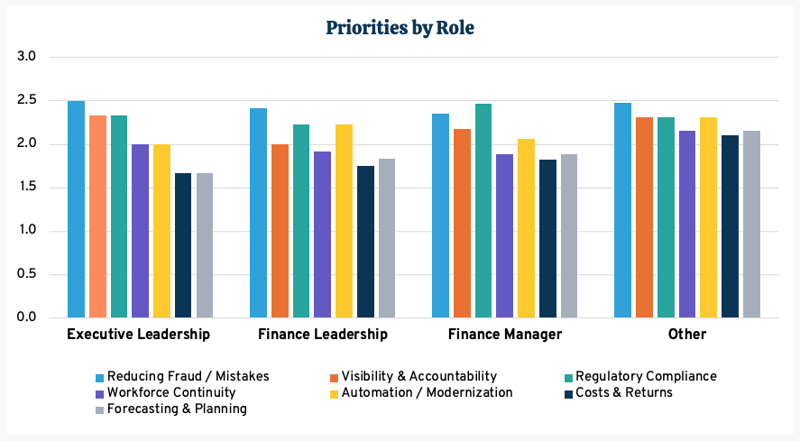
Executives place the greatest emphasis on reducing fraud, ensuring compliance, and maintaining visibility which are all key to preserving public trust. For them, the biggest concern isn’t just the work itself, but the continuity of knowledge within their teams which follows right behind with modernization.
Finance leaders sit in the middle ground, balancing strategic risk with operational efficiency. They’re equally focused on fraud prevention and compliance but also see automation as the bridge to long-term modernization.
Meanwhile, finance managers feel the day-to-day pain of manual processes most directly. Their focus remains on staying compliant and error-free but they place nearly equal importance on visibility and automation.
Workforce continuity is also rising in importance across all roles, especially executives. As retirements accelerate and teams become leaner, leaders are recognizing how fragile institutional knowledge can be.
Based on the responses, everyone values accountability and transparency, but what that looks like, and where the pain points lie, depends on their position in the organization.
The Barriers Holding Teams Back
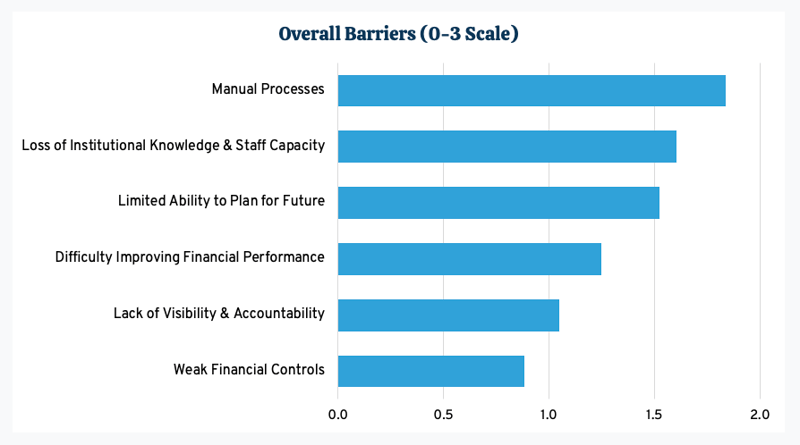
If priorities reveal where public finance leaders want to go, barriers show what’s holding them in place.
Source: DebtBook Survey
One obstacle stands out above all the rest: manual processes.
Whether it’s juggling spreadsheets, managing siloed systems, or relying on email for critical workflows, manual work continues to drain time and increase risk across every sector and budget size.
Closely behind workforce turnover remains a persistent concern, especially for local governments and utilities.
Losing experienced staff means the loss of institutional knowledge that teams rely on to stay compliant and efficient.
The next barrier is planning and forecasting limitations.
Public finance leaders recognize the need to look ahead, but too often they lack the tools or capacity to forecast with accuracy. This gap between intent and capability underscores a growing demand for modernization.
Taken together, these barriers reinforce that modernization is no longer optional. Reducing reliance on spreadsheets, automating routine tasks, and preserving knowledge within systems are essential steps to keep public finance operations resilient.
“DebtBook’s huge repository allows the user to store vital information as it relates to all things municipal bond related. Whether it's keeping track of compliance deadlines for CDIAC and MSRB related filings or running hypothetical number runs for an upcoming bond issuance, the program is there to assist you every step of the way.”
Pete Papadakis, Finance Analyst at Los Angeles County
Where Assumptions Were Challenged
Not every finding aligned with what we expected to see. Some results challenged long-held assumptions about how public finance leaders set their agendas.
First, financial performance consistently ranked lowest as a priority. Even in an environment of tightening budgets, leaders placed more weight on compliance, transparency, and fraud prevention than on reducing borrowing costs or maximizing returns. The message they shared was protecting trust outweighs chasing marginal financial gains.
Second, forecasting and planning revealed an interesting gap. As stated priorities, they appeared further down the list.
Source: DebtBook Survey
Yet when asked about barriers, limitations in forecasting emerged strongly. This disconnect suggests an untapped demand, leaders may not be prioritizing forecasting explicitly, but they feel its absence when making decisions.
Source: DebtBook Survey
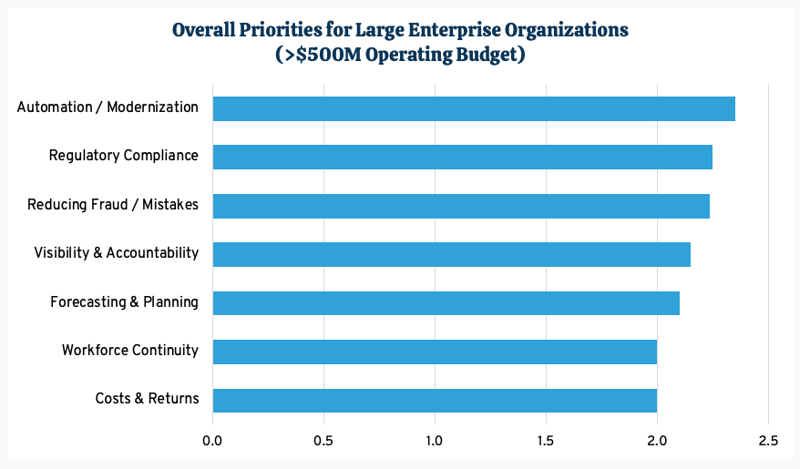
Finally, large enterprise organizations broke the mold. Compliance dominated as the primary goal across respondents except for the largest entities where modernization and automation rose to the top. With greater resources and established compliance processes, these organizations are more focused on future-proofing and efficiency at scale.
These surprises are a reminder that modernization strategies can’t be one-size-fits-all since what resonates with a small municipality may not land with a university system or a billion-dollar state agency.
Moving Forward
The survey results show public finance leaders are united in their focus on reducing risk and protecting trust. Yet they are equally united in what’s holding them back- manual processes, forecasting gaps, and workforce turnover.
Modernization offers a way to streamline workflows, preserve institutional knowledge, and create the visibility leaders need to make confident decisions.
Explore how DebtBook helps public finance teams reduce manual work, strengthen compliance, and plan more strategically.
Source
All data cited in this article is drawn from DebtBook's 2025 Public Finance Leaders' Top Priorities Survey. The survey included respondents representing local and state governments, higher education institutions, utilities, and healthcare organizations across the United States. Participants spanned a range of roles from executives and finance directors to managers and accountants, and organizational budgets ranging from under $10 million to over $500 million.
Related Treasury Management Reading
- What System is Protecting Your Public Funds from Fraud?
- Why Public Finance Leaders Need a Modern Treasury Management Solution
- How Capital Project Management Helps Public Finance Teams Track Every Dollar
Disclaimer: DebtBook does not provide professional services or advice. DebtBook has prepared these materials for general informational and educational purposes, which means we have not tailored the information to your specific circumstances. Please consult your professional advisors before taking action based on any information in these materials. Any use of this information is solely at your own risk.


.jpg)
.jpg)
.jpg)