



.jpg)
A strong Investment Policy Statement (IPS) does more than define permissible investments. It helps organizations connect cash flow planning, liquidity management, governance, and investment decision-making into a single framework. Yet in our view, many investment policies fail to achieve that goal.
Based on DebtBook's work helping organizations forecast and plan for future cash needs and Sterling Capital Management's more than 50 years of institutional investment experience reviewing thousands of investment policies, we've identified six common mistakes organizations make when developing and maintaining an IPS.
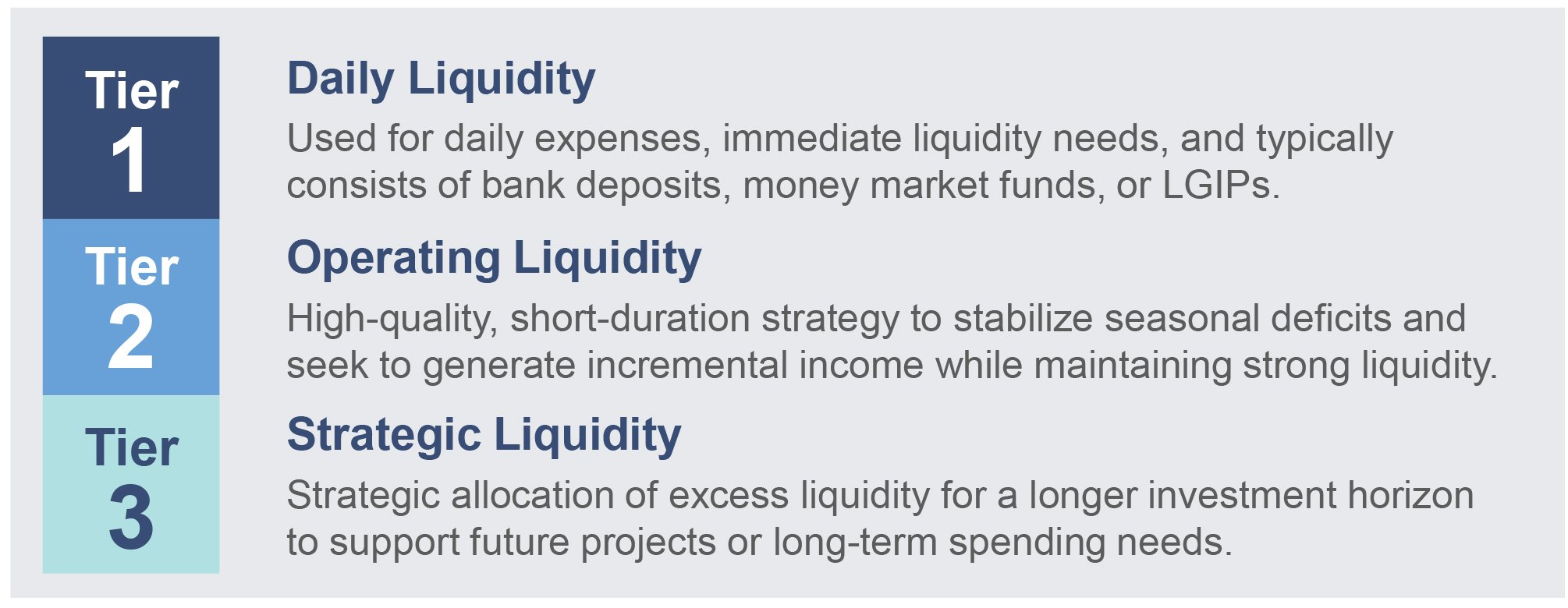
1. Managing All Cash the Same Way
Not every dollar has the same purpose. Operating cash, reserve funds, debt service funds, bond proceeds, and strategic reserves often have vastly different time horizons and liquidity needs. Yet many organizations continue to manage all cash as a single investment pool.
Source: Sterling Capital Management Analytics. For illustrative purposes only.
2. Investing Without a Clear Understanding of Future Cash Needs
One of the most common challenges we encounter is organizations making investment decisions before fully understanding when cash will be needed.
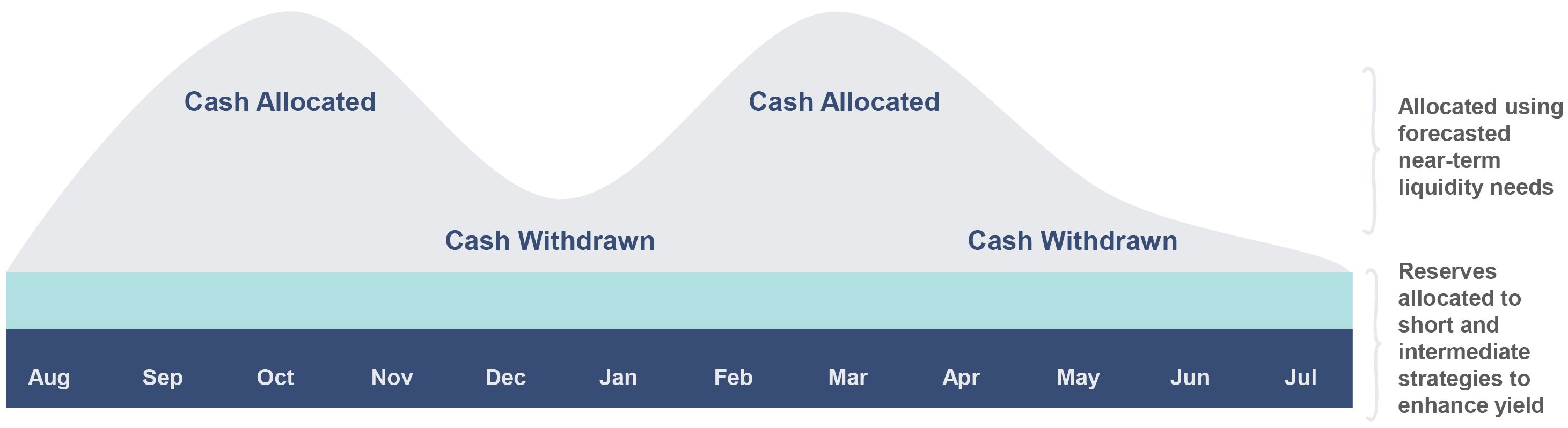
Reliable cash flow forecasting helps Finance and Treasury teams determine how much liquidity should remain readily accessible and how much can be invested for longer periods. Without this visibility, we believe organizations often maintain excessive cash balances or assume unnecessary liquidity risk.
Good forecasting doesn't eliminate uncertainty, but it can create a stronger foundation for investment decision-making.
Cash flow forecasting may enable more strategic investment allocations
Source: Sterling Capital Management Analytics. For illustrative purposes only.
3. Treating the Investment Policy Statement as a Compliance Document Only
In our view, many investment policies are reviewed during annual board meetings and then placed on a shelf until the following year.
An effective IPS should actively guide decision-making throughout the year. It should help define investment objectives, establish accountability, support manager oversight, and provide a framework for evaluating opportunities as market conditions evolve.
The strongest policies become operating documents as opposed to filing requirements. For example, investment policies should outline items such as credit quality requirements, maturity limitations, interest rate risk, treatment of security or issuer downgrades, performance measurement, and portfolio oversight procedures.
4. Failing to Clearly Prioritize Safety, Liquidity, and Return
Most investment policies reference safety, liquidity, and return. Fewer clearly define how those objectives should be prioritized in our view. When priorities are not clearly established, decision-making can become inconsistent during periods of market volatility or changing liquidity needs.
For most organizations, preservation of principal and liquidity should remain the primary objectives, with return optimized only after those goals have been satisfied.
Clearly prioritizing safety, liquidity, and return also creates a framework for evaluating investment decisions under different market environments. Periodically assessing how a portfolio may respond to changes in interest rates or liquidity conditions can help organizations better understand potential tradeoffs before those scenarios occur.
5. Maintaining an Outdated Authorized Investment List
As investment markets evolve, so should organizations that manage public funds. Statutory requirements, regulatory guidance, and industry best practices continue to change over time.
However, many policies are updated infrequently and contain investment guidelines that no longer reflect current market opportunities, organizational needs, or best practices.
We believe a well-constructed IPS should provide appropriate flexibility while maintaining prudent risk controls and compliance with applicable regulations.
6. Assuming Investment Management is a Part-Time Responsibility
Many organizations assign investment responsibilities to finance teams whose primary focus is budgeting, accounting, debt management, treasury operations, or other financial functions. While those teams may be highly capable, investment markets continue to grow more complex. Credit conditions change, yield curves shift, sectors evolve, and investment opportunities emerge that may require ongoing monitoring and specialized expertise.
Organizations should periodically evaluate whether their internal resources, expertise, and available time remain aligned with the complexity of the investment program.
In some cases, outside investment managers, consultants, or other qualified partners may help strengthen governance, risk management, portfolio oversight, market intelligence, and credit research. They may also provide access to a broader network of broker-dealers, creating additional visibility into market opportunities and more competitive trade execution.
Reviewing these common mistakes can help organizations identify where their current policy may need additional clarity, flexibility, or structure.
A strong investment policy statement helps connect governance, liquidity planning, cash flow management, and investment decision-making into a single framework. To help organizations evaluate and strengthen their own policies, Sterling Capital has developed a sample Investment Policy Statement that incorporates many of the concepts discussed above.
Download the sample IPS to see how a modern investment policy can be structured and identify opportunities to strengthen your organization's investment program.
Adnan B. Virani, CAIA®, CTP® is Executive Director at Sterling Capital Management, where he serves as a Senior Client Strategist working primarily with governments, not-for-profits, and family offices. He brings over a decade of institutional investment experience, with prior roles spanning capital markets and investor relations at FD Stonewater and HRI Hospitality, and consultant and institutional client relations at PIMCO. Adnan holds a B.S. in Management from Georgia Tech and an M.Ed. from Harvard Graduate School of Education.
404.542.4912
John Barrett, AIF® is a Director at Sterling Capital Management, where he works as an Institutional Client Strategist focused on serving and growing the firm's not-for-profit and governmental client base. He brings nearly a decade of industry experience, with prior roles including investment portfolio management for institutional clients at Truist Financial, fixed income investment committee work at BB&T Institutional Investment Advisers, and brokerage investment at Vanguard. John holds a B.S. in Business Administration with a concentration in Finance from North Carolina State University.
919.810.9883
The opinions contained reflect those of Sterling Capital Management LLC (SCM), are for general information only, and are educational in nature. This information and the opinions expressed are as of the date of publication and are subject to change without notice. These opinions are not meant to be predictions and do not constitute an offer of individual or personalized investment advice. They are not intended as an offer or solicitation with respect to the purchase or sale of any security. All opinions and information herein have been obtained or derived from sources believed to be reliable. SCM does not assume liability for any loss which may result from the reliance by any person upon such information or opinions.
Investment advisory services are available through SCM (CRD# 135405), an investment adviser registered with the U.S. Securities & Exchange Commission (SEC) and an indirect, wholly-owned subsidiary of Desjardins Global Asset Management Inc., which is part of the Desjardins Group. SEC registration does not imply a certain level of skill or training, nor an endorsement by the SEC. SCM manages customized investment portfolios, provides asset allocation analysis, and offers other investment-related services to affluent individuals and businesses.
Related Treasury Management Reading
- Why Public Finance Managers Need a Modern Treasury Management System
- Breaking Down the Math Behind Municipal Bonds
- Debt Service Calculator for Tax-Exempt Bonds
Disclaimer: DebtBook does not provide professional services or advice. DebtBook has prepared these materials for general informational and educational purposes, which means we have not tailored the information to your specific circumstances. Please consult your professional advisors before taking action based on any information in these materials. Any use of this information is solely at your own risk.


.jpg)
.jpg)
.jpg)