


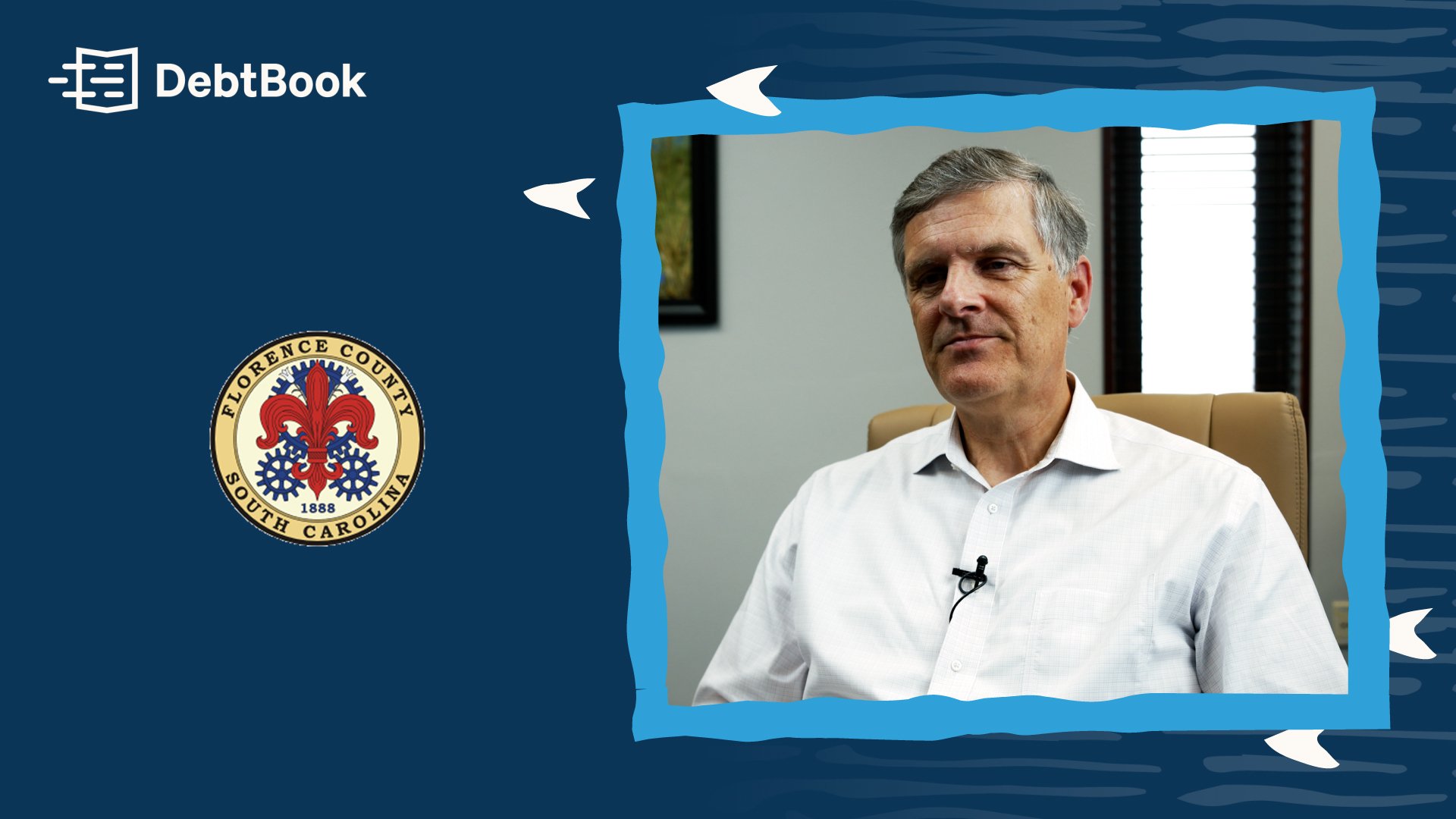
Watch the Full Story
For Florence County Administrator Kevin Yokim, the value of DebtBook is straightforward: confidence, consistency, and control.
“It’s such a great tool to help a local government manage its debt, keep track of everything, keep track of the accounting, do the financial annual reporting, and do the forecast and analysis. It’s almost a required tool in your toolbox now.”
Kevin has served as Florence County Administrator in South Carolina for nearly three years, bringing with him deep experience as a former finance director. That background made it clear early on that managing debt without a centralized system creates unnecessary risk, especially during staff transitions.
Florence County needed a better way to ensure continuity, accuracy, and long-term institutional knowledge.
The Challenge: Consistency, Transitions, and Manual Work
Before implementing DebtBook, Florence County faced challenges that are common across local governments:
-
Debt knowledge lived with individuals, not systems
-
Reporting consistency depended heavily on who was in the role
-
Training new finance staff took significant time
-
Debt documents, allocations, and schedules required constant checking and re-checking
As staff changed, the risk grew.
“DebtBook helps the transition from one member of the finance team to another. The learning curve is a whole lot shorter. It doesn’t take as long to educate upper level finance staff in debt management and all the other bond issues than it did previously.”
Kevin had firsthand experience with how time-consuming that process could be.
“When I would have a new accounting manager, when I was finance director for a number of years, sitting down with them and explaining to them each bond issue and when the payments were due and how they were paid took time. And now with DebtBook that shortens that timespan dramatically.”
The Solution: Centralized Data That Doesn’t Walk Out the Door
With DebtBook, Florence County gained a single, reliable system of record for its debt.
“Prior to DebtBook, ensuring that we were keeping track of all of our bond documents and all of our bond issuances, there was some concern. Now that we have DebtBook, as finance team members transition in and out, that’s not an issue. Once you put it in DebtBook it’s staying there and it’s not going away.”
That permanence removed a major source of risk and stress for the finance team.
DebtBook also transformed how Florence County handled debt allocations, an area that had previously required extensive manual work.
“Prior to DebtBook, not only did we struggle with keeping track of all of our debt, but also the allocation of all of our annual debt payments and what funds they went into and what revenue sources funded them.”
With DebtBook, that process became automatic.
“Now that we have DebtBook, it’s virtually automatic on how those allocations are made and we don’t have to go through and check and double check and re-enter and make sure everything is how it’s supposed to be. Once you put it in DebtBook, it’s added once and then it’s done.”
The Impact: Faster Analysis, Better Planning, Total Confidence
Beyond day-to-day efficiency, DebtBook gave Florence County a stronger system for decision-making.
“The other big value add that DebtBook has is it makes it very easy to do debt analysis and debt forecasting and planning. It’s very intuitive when you have to go looking for information, it’s very easy to find and see how much debt you have outstanding at one time and see when payments are due.”
For Kevin, consistency is the key differentiator.
“It’s a robust platform and it’s 100 percent consistent. You put the data in and you get it back out the way you need it.”
That reliability allows the finance team to shift their focus away from manual work and toward higher-value analysis.
“I think any local government organization that issues debt needs to take a hard look at DebtBook. They do the number crunching, so we can do the higher ordered thought process evaluation and it takes all those manual tasks off the table so that we can spend the time doing the things that we should be doing.”

.jpg)
.jpg)
.jpg)